Perler bead keychains
Every design here carries its own loop: a five peg tab on the top edge with the centre peg left empty, so a jump ring passes through the fused piece and nothing has to be melted through with a hot skewer afterwards.
36 free patterns ·
Drawn and checked by  Ivy Skein
How do you turn perler beads into a keychain that lasts?
Fuse both faces, not one. Iron until the beads join with their holes still visible, flip the piece over on the paper and press the back the same way, then cool it flat under a book. Thread a 6mm jump ring through the loop hole and close it onto a split ring.
Mini charms for a first keychain
Six charms at 13 pegs across, two or three colours each and between 70 and 130 beads. That is the size that finishes in one sitting and still sits flat in a pocket next to a car key. Make one of these before you make anything below it: the loop tab behaves the same on every design here, so a mini is the cheapest way to learn how tightly to press it.


Food and drink charms
Six food charms at 15 and 17 pegs, and the group where the colour lists get long: the ramen bowl alone runs to six colours, with noodles, nori, a halved egg and a checked rim. Food designs are the ones people ask for by name on a school bag, and they are also the best test of whether your bead stash actually has the mid tones a design needs.


Animal charms
Six animals drawn as faces or as whole bodies, never as outlines with a face floating inside. Each one keeps its thinnest part at least two beads wide, because an ear or a tail one bead thick is the piece that snaps off in a bag within a week. The bear, corgi and hedgehog are faces; the whale, shark and duck are full bodies.


Lucky charms and symbols
Clover, horseshoe, moon, hearts, wishbone and a shooting star, in the group where the loop placement had to be argued with the drawing. A horseshoe is open at one end and a clover is notched at the top, so both were redrawn until there were solid beads under the tab. The shooting star is the only design on the page whose loop is deliberately off centre.


Arcade and gadget charms
Six objects rather than characters: a pad, a stick, a token, headphones, a disk and a twenty sided die. This site does not publish charts of game characters, because a bead chart of somebody else's artwork is a derivative work of it, so this group is drawn as the hardware instead. It is also the densest group on the page, with the pad and the disk at 255 beads each.


Bag charms for a lobster clip
The biggest six, from 15 to 19 pegs wide and up to 23 tall, which is past the size you want swinging off a house key and exactly right clipped to a rucksack zip. Use a swivel lobster clasp rather than a split ring on these: the swivel is what stops a long charm like the guitar from twisting itself against the zip pull all day.


How to read one of these charts
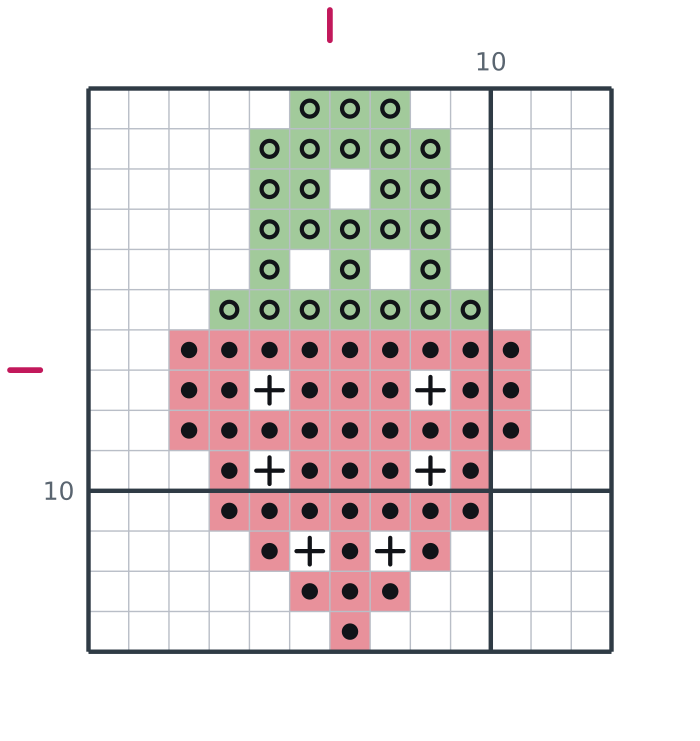
- One square is one full cross stitch, one bead or one pixel. The symbol in the square tells you which colour goes there.
- The heavy lines every ten squares are counting lines. Count in tens and a miscount shows up in the same row it happened.
- The small marks on the top and left edges mark the centre of the design, which is where most people start.
- The key under the chart lists every symbol with its colour, our thread code and how many squares of it the design uses.
What is different about these charts
Every other bead chart on this site is a picture. These are a picture plus a fixing point. Each design carries a tab five pegs wide on its top edge with the middle peg left empty, and two beads of material above that gap and two on each side. Once the piece is fused, that empty peg is a real hole about 5mm across, which a 6mm jump ring passes through without being forced and without splitting the design.
The alternative, and the method the perler bead ideas page describes for its keyring group, is to heat a metal skewer and push it through a corner bead while the piece is still warm. That works, but it puts the hole wherever the bead happens to be, it melts a burr you then have to trim, and on a design with a face it usually ends up through somebody's ear. Drawing the hole into the grid removes all three problems.
The hardware, in the order you attach it
A jump ring goes through the fused hole first. A 6mm ring in 0.8 to 1mm wire is the right size: smaller and it will not clear the bead walls, larger and the charm hangs loose enough to catch. Open a jump ring by twisting the ends past each other sideways, never by pulling them apart, or it will never close flush again.
What the jump ring then joins is the choice that matters. A split ring is the flat coiled type on a house key: fiddly to fit, almost impossible to lose. A swivel lobster clasp clips on and off and turns, which is what the bigger charms want on a rucksack zip. A phone charm strap, the thin corded loop, only suits the minis: it is rated for a few grams, and a 250 bead fob will pull it out of the case.
Perler, Hama, Artkal and the peg spacing
These are brand names for the same 5mm fuse bead, and every chart here is drawn for that size, so any 5mm bead works and any standard 5mm pegboard holds them. The names people search are different by region, which is the only reason it is worth spelling out: perler and melty in the United States, hama in Europe, artkal for the smaller 2.6mm mini beads. Mini beads at 2.6mm will not fit a standard board and will shrink these designs to about half size, which is genuinely nice for the minis and unreadable for the arcade group.
Widths on this page run from 13 to 21 pegs and heights from 11 to 23, so the largest design still sits inside a single 29 peg square board with room around it. Nothing here has to be split across two boards and joined after ironing.
Fusing both sides, and sealing
A keychain lives in a bag with keys, and a piece fused on one face only will come apart along an unfused seam the first time it is bent. Cover the design with the ironing paper and press in slow circles on a medium heat with no steam until the beads join but each still shows its hole. Let it cool for a minute, lift the paper, turn the whole piece over onto fresh paper and press the back in exactly the same way. Then leave it flat under a heavy book for ten minutes: a charm cooled in open air curls, and a curled charm cracks at the curl.
Sealing is optional and mostly cosmetic. A light coat of clear acrylic spray on both faces evens out the melted surface and keeps pale colours from picking up denim dye, which is a real problem with white and cream in a back pocket. Do not use a brush on varnish: it pools in the bead holes and dries cloudy. Nothing you spray will make a one sided fuse hold, so fix the fusing first.
Where the rest of the designs are
If you want the same subjects as flat charts without the loop tab, the perler bead patterns page is the chart library, sorted by subject and drawn for a standard pegboard. If you have not decided what to make yet, perler bead ideas files coasters, magnets, bookmarks and hangers alongside its keyrings. To turn a picture of your own into a chart, the Pattern Maker does it in a few seconds, and the printable pixel art grids are there if you would rather draw the charm yourself before you buy a single bead.
Everything here is drawn in house, square by square, and there are no licensed or recognisable characters on this page for the reason set out on the license page, which also confirms that you may sell the keychains you make from these charts.
How to use these bead patterns
- Print the chart or keep it on a screen beside you, then set the beads out on a standard square pegboard.
- Work one colour at a time from the chart. Every design here fits one board, so nothing has to be joined later.
- Iron through the paper on a medium heat until the beads just join, then cool it flat under a book so it does not curl.
Common questions
What size jump ring fits the hole in these patterns?
A 6mm jump ring in 0.8 to 1mm wire. The loop hole is one empty peg, which comes out about 5mm across once the beads around it have fused, so a 6mm ring passes through without being forced. Open it by twisting the two ends past each other sideways rather than pulling them apart, or the ends will never sit flush again when you close it.
Split ring, lobster clasp or phone strap?
A split ring is the flat coiled type already on your house keys: awkward to thread, almost impossible to lose. A swivel lobster clasp clips on and off and turns, which is what the bigger designs want on a rucksack zip. A corded phone charm strap is only rated for a few grams, so keep it for the 13 peg minis and never hang a 250 bead fob off one.
Do I have to iron both sides of a keychain?
Yes, and this is the one step people skip. A charm fused on one face only has an unfused seam running through it, and a bag full of keys will find that seam. Press one side until the beads join with their holes still showing, let it cool a moment, turn it over onto fresh paper and press the back the same way. Cool it flat under a book or it curls.
Will perler, hama and artkal beads all work?
Any 5mm fuse bead works, whatever the packet calls it, because every chart here is drawn for the 5mm size and a standard 5mm pegboard. The 2.6mm mini beads are a different product: they need their own board and they shrink these designs to roughly half size, which suits the mini charms and makes the arcade group unreadable.
Should I seal a bead keychain with varnish or spray?
Only if you want to. A light clear acrylic spray on both faces evens out the melted surface and stops pale beads picking up dye from denim, which really does happen to white and cream in a back pocket. Avoid brush on varnish: it pools in the bead holes and dries cloudy. No coating will rescue a piece that was only fused on one side.
Why do these charts have a tab on top?
Because that tab is the hole. Five pegs wide with the centre one empty, two beads above it and two either side, so the ring hangs off solid material instead of a single bead bridge. If you would rather have the plain design, the same subjects without a loop are on the perler bead patterns page, and the perler bead ideas page shows the hot skewer method for charms that were not drawn with a hole.