Perler bead ideas
Ideas sorted by the thing you end up holding: a charm on your keys, a coaster under a mug, a magnet on the fridge door. Every idea comes with the chart that makes it.
35 free patterns ·
Drawn and checked by  Ivy Skein
What can you actually make with perler beads?
Anything flat that a fused sheet of beads can become: keyring charms, drinks coasters, fridge magnets, bookmark toppers, hanging decorations and small animal figures. This page groups 35 ideas by the finished object rather than by subject, so you can pick the project first and the design second.


How to read one of these charts
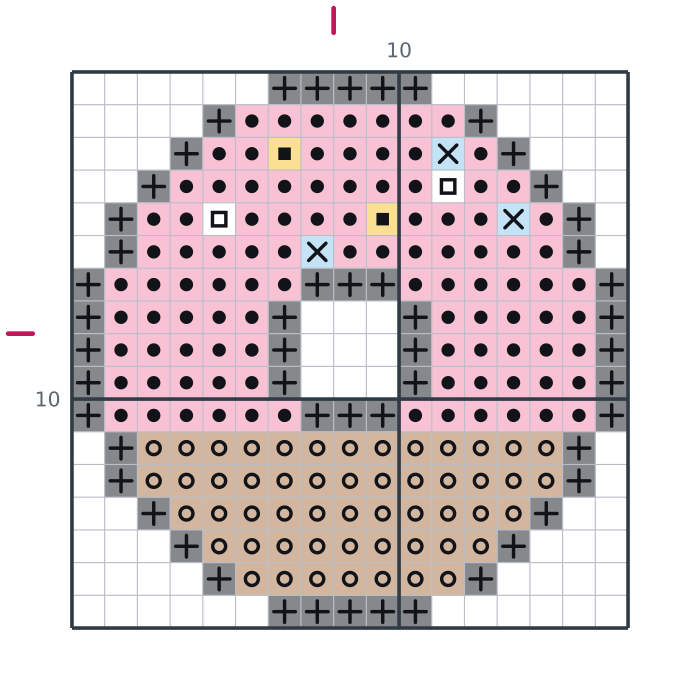
- One square is one full cross stitch, one bead or one pixel. The symbol in the square tells you which colour goes there.
- The heavy lines every ten squares are counting lines. Count in tens and a miscount shows up in the same row it happened.
- The small marks on the top and left edges mark the centre of the design, which is where most people start.
- The key under the chart lists every symbol with its colour, our thread code and how many squares of it the design uses.
What this page is for
Every design below is filed under the object it turns into once the beads are fused: a charm on a keyring, a coaster under a mug, a magnet on a fridge door, an animal to stand on a shelf, a topper for a bookmark, a shape to hang on a thread. If you already know the design you want and only need the counted chart, the perler bead patterns page is the chart library, sorted by subject. This one is the project list, sorted by what you end up with.
The six project types
Keyring charms are small, 13 to 19 pegs across, because a charm bigger than a car key is a nuisance in a pocket. Coasters are the opposite, 24 to 27 pegs square, which is as wide as a design can be and still fit one standard board. Fridge magnets sit in between and stay flat and wide so a self adhesive disc has something to grip. The animals are the group people search for by name. Bookmark toppers are long and narrow so the strip still shows above a closed paperback, and the hanging decorations are each drawn as one connected piece so nothing has to be joined after ironing.
Turning a fused design into the thing itself
A charm needs a hole, and there are two ways to get one. The designs on the perler bead keychain page have it drawn into the grid already, as an empty peg with beads all round it. For the charms on this page, heat a metal skewer, push it through one corner bead while the piece is still warm, and thread a 6mm jump ring through it. A coaster needs a second press, both faces ironed, then cooled flat under a heavy book for ten minutes or it curls the first time a hot mug lands on it. A magnet needs two 20mm self adhesive discs, one near each end, so the design cannot pivot on the door. A bookmark needs nothing at all beyond a tassel if you want one.
Every design here is drawn in house
There are no licensed characters on this page and there will not be, because a bead design made from somebody else's character is a derivative work of their artwork and this site publishes only what it draws itself. What you may do with these designs, including selling the pieces you make from them, is set out on the license page. If you want a project that is not here, the Pattern Maker will chart your own picture, and the pixel art templates page has more subjects on the same square grid.
How to use these bead patterns
- Print the chart or keep it on a screen beside you, then set the beads out on a standard square pegboard.
- Work one colour at a time from the chart. Every design here fits one board, so nothing has to be joined later.
- Iron through the paper on a medium heat until the beads just join, then cool it flat under a book so it does not curl.
Common questions
How do I put a keyring on a finished bead charm?
Make the hole while the piece is still warm from the iron, not after it has gone hard. Hold a metal skewer or a thick needle over a flame for a few seconds, then push it straight through a single bead near one corner and pull it back out. That leaves a clean round hole for a 6mm jump ring, which the keyring or lobster clasp then clips onto.
Will a bead coaster survive a hot mug?
Yes, if you iron both faces and cool it properly. Press one side until the beads join, turn the piece over on the paper and press the other side, then leave it flat under a heavy book for ten minutes. A coaster cooled in open air curls at the corners, and a curled coaster rocks under the first hot mug that lands on it. Use a cork or felt backing if you want it silent.
What kind of magnet should I glue to the back?
Self adhesive neodymium discs of about 20mm, and two of them rather than one. A single magnet in the middle lets the design swing and end up crooked on the door within a day. Two, placed near opposite ends of the piece, hold it square and carry a stack of paper as well.
Which of these projects is best for a first go?
Start with one of the fridge magnets or a keyring charm. They are between 13 and 23 pegs across, they use four or five colours, and they finish in one sitting, so a mistake costs a few minutes rather than an evening. The coasters are the ones to leave until last: at 24 to 27 pegs square they are several hundred beads each.
Can I make these bigger than one pegboard?
Not without joining boards. Everything on this page is drawn to fit inside a single standard square board, which is why the coasters stop at 27 pegs. If you want the same design at double size, work it in cross stitch instead: the grid is identical, and the finished size on 14 count aida is printed on every card here.
Where are the charts for these ideas?
On this page. Every card carries its own printable PDF and its own chart image, exactly like the ones on the perler bead patterns page. The difference between the two pages is how they are sorted: that one is filed by subject, this one is filed by the object you end up with.