Free cross stitch patterns
Forty eight counted charts in eleven groups, drawn here square by square: flowers, fruit, garden creatures, wide landscapes, large designs for a frame, abstract squares, small and tiny charts, charts worked in one thread, charts made for seed beads, and repeating bands for linens. Every one comes with a symbol chart, a colour key and a printable PDF, and every one is free.
48 free patterns ·
Drawn and checked by  Ivy Skein
Are these cross stitch patterns really free to print?
Yes. Every chart on this page is a free PDF with no account, no email and no watermark. Print as many copies as you like, at home or for a class or craft group, and sell the pieces you stitch from them. The only things ruled out are selling the chart itself and re-uploading the file elsewhere.
Flower charts
Five garden flowers, and the group where the colour lists run longest. The rose alone shades through three pinks to make the folded petals read as a spiral, and the daisy needs a pearl grey edge or the white petals disappear into pale aida. Grids sit between 24 and 26 squares, so each one finishes around 4.5 cm across on 14 count.


Fruit, nuts and leaves
A strawberry, a pair of cherries, an acorn, an oak leaf and a pine tree. This is the three colour end of the page, and the group to raid when you want a set of matching gift tags rather than one framed piece, because none of the five shouts over the other four.


Garden creatures
A robin, a bee, a butterfly and a snail, every one drawn side on so the silhouette does the work before any shading gets a chance to. The robin and the snail carry six colours each, the most anywhere on this page, and both repay being stitched on a higher count fabric than the flowers need.


Landscapes and scenery
Four wide scenes, and the only charts here that show a place rather than an object. Every one is stitched edge to edge with no fabric left bare, because a landscape lives on the joins between sky, ridge and water and a gap in the middle of one of those reads as a hole rather than as air. They run 44 to 56 squares across, which is 8 to 10 cm on 14 count, and each is close to 1,900 stitches.


Large charts, over 45 squares each way
Three designs bigger than 45 squares in both directions, which is the point where a chart stops fitting a small hoop. All three deliberately leave fabric showing, so they cover a lot of cloth without being a lot of stitching: the canopy of the tree is charted as separate leaves, the basket stands on bare linen, and the peacock tail is twenty individual feathers rather than one filled shape.


Abstract and geometric charts
Four charts with no subject at all, which is what makes them the ones to reach for when the finished piece is a cushion front, a book cover or a framed square rather than a picture of something. Three of them fill the grid completely on a rule you can carry past the edge in any direction. The mandala is the odd one out: a closed medallion that finishes where its outer rail closes and cannot be extended.


Small charts that keep their shading
Five charts that stop at 20 squares across and still spend five or six colours inside that space. This is the combination nothing else on the site offers: the beginner charts are small AND simplified down to four threads, while these are small and fully shaded, so the pear still has a shadow side and a rosy cheek at 2.9 cm across.


Tiny charts, nine squares across at most
Five charts that stop at nine squares wide, about 1.6 cm finished on 14 count, and the smallest anything on this site gets. They are not the beginner minis shrunk down: those are two colours and blocky on purpose, while these spend three to five threads inside eight or nine squares, so the pine cone keeps a lit edge and the thimble keeps its dimples. Drawn to be scattered, six along a hem rather than one in a frame.


One colour charts
Four charts worked top to bottom in a single thread, which means one symbol on the whole chart and not one colour change from the first stitch to the last. A one colour piece stands or falls on its outline, so these are drawn larger than anything else here, up to 30 squares deep, with bare fabric left inside the shape where a shaded chart would have reached for a second colour.


Beaded charts, one bead to a square
Four charts worked in seed beads instead of thread: a half cross stitch with one bead picked up on it, so a square on the grid is a bead on the cloth and the count printed on the chart is a bead count. Size 11 beads sit right on 14 count aida, and the key names a colour rather than a brand so you can match it to what you already have. They are drawn more openly than the stitched charts because a bead needs bare fabric around it to catch the light.


Repeating bands and motifs for linens
Four repeating bands and the teacup, grouped because they are what goes on cloth you actually use: a hem, a tea towel, a napkin corner, the end of a bookmark. Every band is one 11 square unit repeated four times across 44 squares, so you can stop after a single repeat or carry the same unit along a metre of edging.


How to read one of these charts
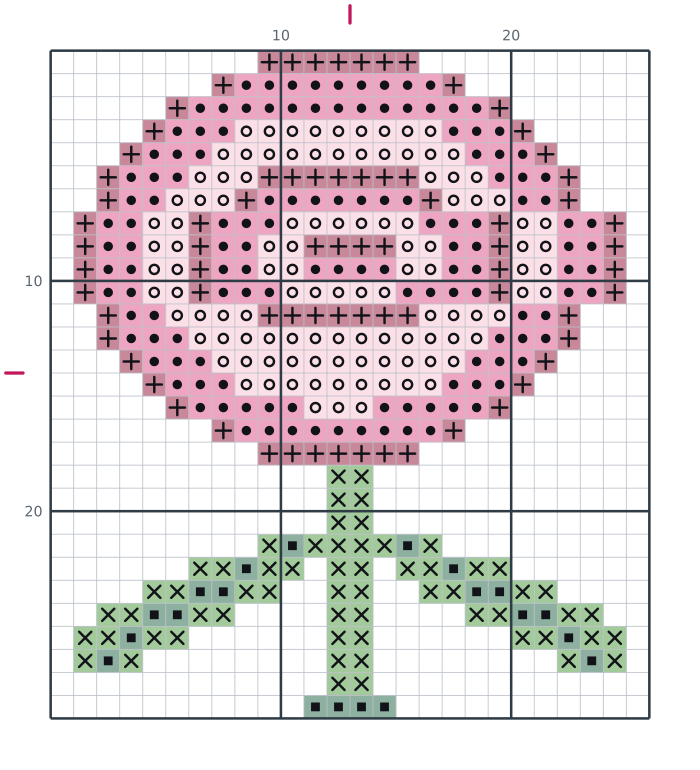
- One square is one full cross stitch, one bead or one pixel. The symbol in the square tells you which colour goes there.
- The heavy lines every ten squares are counting lines. Count in tens and a miscount shows up in the same row it happened.
- The small marks on the top and left edges mark the centre of the design, which is where most people start.
- The key under the chart lists every symbol with its colour, our thread code and how many squares of it the design uses.
What is on this page
These are counted cross stitch charts: a grid where one square is one full cross stitch, with a symbol printed in each square and a key that names every colour. They are drawn on the grid they print on, so nothing is scaled, blurred or approximated between the design and the chart in your hands.
There are 48 charts here, filed under eleven headings. Four of them are subjects: flowers, fruit and leaves, garden creatures, and landscapes. The other seven are about the way the chart is built rather than what it shows: large designs for a frame, abstract squares, small charts that keep full shading, tiny charts under ten squares, designs worked in a single thread, charts made for seed beads, and repeating bands. Grid widths run from 7 to 56 squares, which on 14 count aida is roughly 1.3 to 10 cm across, so the smallest finishes in half an hour and the widest is a framed picture.
Which chart to start with
If you have never counted a chart before, start on the beginner cross stitch patterns page instead: those designs use two to four colours and small grids on purpose. Three groups on this page get called small at some point and they are not the same thing. Beginner charts are reduced: fewer threads, blockier shapes, nothing that has to be counted twice. The small charts here are simply compressed, and they still ask for five or six colours inside 20 squares. The tiny charts go smaller again, nine squares wide at the most, and still carry three to five threads inside that, which is why the pine cone keeps a lit edge at 1.5 cm across. If you want to add a name, a date or initials to a finished piece, the cross stitch alphabet is drawn to the same weight as these designs, so the two sit together without looking mismatched.
What counted means, and what it rules out
Counted cross stitch means the fabric carries no printed design at all. You work from the chart and count squares, which is why every chart here has a heavy guide line every ten squares, numbers down the left and along the top, and a mark on each edge showing where the centre falls: you start in the middle of a bare piece of aida and count outward. The other kind, a stamped kit, has the picture printed on the cloth already and gives you nothing to count. Everything on this page is the counted kind, and every square on every chart is one whole cross in one colour. There is no backstitch outline, no half stitch and no quarter stitch anywhere here, so the chart and the key can never disagree with each other: a square with a symbol is a cross, a blank square is fabric you leave alone, and that rule does not change from the smallest chart to the largest.
Large charts and landscapes
Seven charts here are big: three that pass 45 squares in both directions, and four wide scenes between 44 and 56 squares across. They are a different proposition from the rest of the page and it is worth saying so plainly. The landscapes are stitched edge to edge with no fabric showing, around 1,900 stitches each, because a landscape lives on the joins between sky, ridge and water and a gap in the middle of one of those joins reads as a hole rather than as air. The three large designs do the opposite: the tree keeps its canopy open, the basket stands on bare linen, and the peacock tail is twenty separate feathers, so they cover a lot of cloth without being a lot of stitching. On any of the seven, mark your tens on the fabric with a wash out pen before the first stitch, and finish one area before you start the next rather than working colour by colour across the whole piece.
Working a chart in one colour
The one colour group is the odd one out and the easiest to underestimate. With no colour changes there is nothing to keep track of, but there is also nothing to hide behind: every stitch is either inside the shape or outside it, and a single square in the wrong place shows immediately. Work these from the centre marks outward rather than row by row from a corner, keep the same number of strands throughout, and resist filling the gaps that have been left deliberately, because those gaps are the only drawing the piece has. They are also the fastest charts on the page to finish, since you never rethread.
Working a chart in beads
The four beaded charts are read exactly like the others and worked differently. Instead of a whole cross you make a half cross stitch and pick up one seed bead on the needle as you go, so the bead sits on the diagonal and one square on the chart is one bead on the fabric. Size 11 seed beads sit correctly on 14 count aida. Use a beading needle rather than a tapestry needle, which will not pass through a size 11 bead, and work every bead in the same direction or the finished piece will not lie flat. The key on a beaded chart names a colour and not a brand, so match it against whatever beads you already have. They are charted more openly than the stitched designs because a bead stands proud of the cloth and wants bare fabric around it to catch the light. Nothing stops you beading any other chart on this page the same way; these four are simply the ones drawn for it.
Bands, repeats and how long to make them
Each band is a single unit 11 squares wide, printed four times so you can see the join. Nothing about the chart forces you to stop at four: count the unit once, mark where it starts again, and repeat it for as long as your hem is. Work the straight rails first if the band has them, all the way along, then come back and fill the motifs between them, which keeps a long run from drifting a square off line by the far end. On 14 count aida one repeat is about 2 cm, so a 30 cm tea towel edge takes roughly fifteen. The beaded cuff is charted the same way and cut wherever your wrist finishes.
Turning a photograph into a chart
Nothing on this page is charted from a photograph and none of these designs could be. If what you want is a chart of your own dog, your own house or a face, that is a different job from choosing a motif off a list, and it has its own tool: turn a picture into a cross stitch pattern reduces the image to our thread palette, gives every colour a symbol and hands back the same kind of printable chart you see here. The picture you upload is deleted the moment it has been converted, and only the grid of colour numbers is kept, for as long as it takes you to print it.
Threads, fabric and finished size
Each chart lists its colours with our own codes and plain colour names, plus the number of squares each colour fills, so you can see at a glance whether a colour needs a full skein or a few strands. The finished size printed on every pattern is measured on 14 count aida, the fabric most kits use. On 16 count the same chart comes out about an eighth smaller, on 11 count about a quarter larger, and the stitch count never changes.
Everything here is drawn in house, from the motifs to the colour palette, and is free to use under a plain-language license: stitch it, print it, teach a class with it, and sell the pieces you make from it. Nothing is traced from somebody else's published chart and nothing shows a character somebody else owns, which is also why you will not find a licensed cartoon anywhere on this site.
How to use these cross stitch charts
- Download the PDF and print it at 100 per cent on A4 or Letter paper. Black and white at normal quality is enough.
- Find the centre of your fabric and the centre marks on the chart, then work outwards colour by colour.
- The finished size printed on each pattern is measured on 14 count aida. Finer fabric makes the same chart smaller, not shorter.
Common questions
What fabric count should I use for these charts?
Each chart states its finished size on 14 count aida, which is the fabric most kits use and the easiest to count on. The same chart on 16 count comes out about an eighth smaller, on 11 count about a quarter larger, and on 28 count evenweave stitched over two threads it lands almost exactly the same size as 14 count aida. The stitch count never changes, only the fabric does.
How do I read the symbols and the colour key?
One square on the chart is one full cross stitch. Every colour has its own symbol printed in the square, and the key at the bottom of the PDF lists the symbol, the colour swatch, our thread code, the colour name and how many stitches of it the design uses, so you can see before you start whether you need a whole skein or a few strands.
What do the heavy lines every ten squares mean?
They are counting lines. Every tenth row and column is drawn thick so you can count in tens instead of ones, which is how a miscount gets caught before it becomes ten rows of unpicking. The small marks on the top and left edges show the centre of the design, which is where most stitchers start.
Can I sell things I stitch from these patterns?
Yes. You can sell finished pieces you stitched yourself, at a craft fair or anywhere else, with no permission needed and nothing to pay. What you cannot do is sell the chart itself, or re-upload the PDF somewhere else. The full wording is on the license page.
I have never cross stitched before. Where should I start?
Start on the beginner cross stitch patterns page: those designs are small, use two to four colours and finish in an evening, which is the point. Once counting feels automatic, the designs here have more shading, and the cross stitch alphabet lets you add a name or a date to anything you have already made.
Can I turn my own picture into a chart?
Yes, with the Pattern Maker. You choose how wide the chart should be and how many colours it may use, and it returns a counted chart with a colour key and a printable PDF. Your image is converted and thrown away in the same request: it is never stored, never published and never indexed.